Tuesday, December 6, 2011

5 0f 70 : Palm Cove Golf & Yacht Club, Palm City, Florida

Condos on Palm Cove Golf and Yacht Club


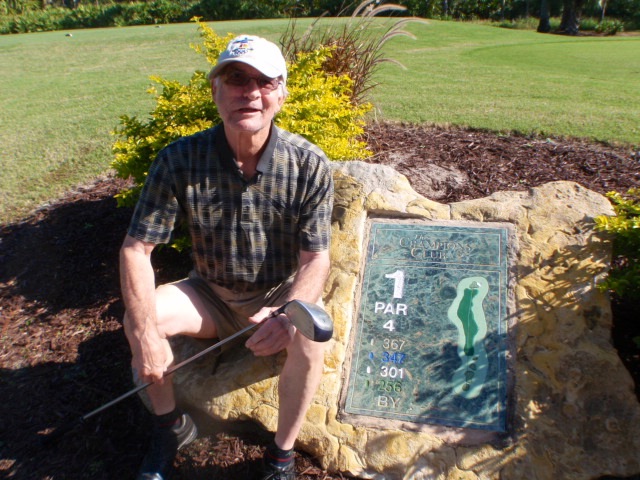
We have played some beautiful golf courses over the last two weeks, some quite wild, like Eagle Marsh and The Champions Club. Palm Cove is beautiful in a very different way, it is routed through a rich and unique development complex, quite well manicured, yet, they have managed to preserve the bird habitat such as marshes and ponds. Palm Cove was originally designed by Gary Player but the developper had issues with Player's original course and commissioned Chi Chi Roriguez and Richard Robbins to redesign the course as it stands today. Rodriguez owns a condo on the property and,  according to the attendant, he was playing at Palm Cove around Thansgiving time. He has since returned to Puerto Rico.

Tee shot over the marsh on #8
The course is short but by no means easy to play. It is what can be called a shotmaker's course which would be well suited to Chi Chi's game. Water comes into play on 16 of the 18 holes, at times so severely that drop zones have been provided such as on holes 1, 2 and 8. Well, on 8 it is due to a marsh over which we both managed to drive safely to post a par (for myself) and a bogey for Brenda, which was a good result on the longest par 3 on the course. We both finished the short front nine with  good scores which led to some expectations of doing well on that day. The longer back nine proved to be less forgiving.


Tee shot on the par 3 17th
That being said, it was still my best game so far as I am slowly seeing some improvement. I had played very little this last year, being too busy with renovations and a major move back to Edmonton. My swing is coming back and with it, more consistency. Some of my drives proved to be too long for this course and ended up in water that was not visible from the tee box. I still managed an 89 in spite of two water balls. Thanks to a neighbour who recommended  Sport Authority, we were able to purchase 6 dozen good balls for the price of one dozen  Titleist ProV1's. Hopefully this will last us for the next five weeks. Our customary match play ended up in my favour this time as I won the 16th hole to finish 4 up with 2 to play. Perhaps we shall consider a skins game for the next round. The last word goes again to Brenda with another picture from Palm Cove.


Sunday, December 4, 2011

4 of 70 : Indian Hills Golf Course, Fort Pierce, Florida

I did make the green, left of the trees and the traps on the right.


Just another fierce windy day on The Treasure Coast. Makes for a challenging round, even when the course is rather tame compare to the last two we played. The attendant told us that the wind has been unabated since Thankgiving at least, and there does not appear to be any break in the weather pattern. It might be good training for the Scottish link courses, if I ever get there. The good news is that  there hasn't been any rain (on the course) so far.
# 10 carry over water
There is water on the Indian Hills course but, fortunately for us, it rarely comes into play, unless you are suicidal and choose to take a short cut to the green like on number 1, a dogleg left over the largest pond on the course. From the gold, a mere 380 yards. From the red tees, 290. In this wind, good luck. Indian Hills Golf Club is a municipal course which, as many municipals, is well maintained but with few frills such as flower gardens and flowering trees. The back nine is prettier and somewhat more challenging. The 10th hole, for example forces you to land your tee shot in what appears to be a Delta and, if you are lucky, you will still have a long second shot to the green over water. Miss your drive short and you have no choice but to layup. Most likely the best hole on this course.
I scored a little better at Indian Hills, shooting a 91 that included a lost ball that should never had been lost. Such is life in golf where the rolls are not always favorable. That ball disappeared over a hill never to be seen again. Well, as long as I'm not yet over the hill, all is good. Brenda showed up big time on the second nine with a deuce on the par 3 eleventh, and then, on twelve she knocked a TV replay sand wedge to the pin and tapped in a 1 footer for par. She was on fire and defeated me 3 and 2 in match play. Yet she had time for great photo shots like this bird on the left. The wildlife on this course was as exciting as ever.

Every time we leave a golf course, the attendants are there to clean and load your clubs in your vehicle, and each time, two things are sure to be said: what a gorgeous truck this is and what a lovely golf bag you have. The «Cadillac» of all trucks belongs to Jean and Yvette. The golf bag is Brenda'a nifty new travel bag.

Friday, December 2, 2011

3 0f 70 : The Champions Club, Stuart, Florida

First Tee at The Champions Club

The Champions Club at Summerfield in Stuart was designed by Tom Fazio the Elder and is considered by some as one of his finest, which is a fine compliment, as Fazio has signed at least 9 of the top 100 courses in America as rated by Golf Digest. It was nominated for the Nation's Best New Course in 1995.
This course was routed amongst pristine wetlands and Fazio was respectful of the environment and wildlife preserve. It is surrounded by a housing complex and yet, Fazio never allows the properties to encroach on the course. The views are incredible and the golfing experience magnificent. We are never, however, completely out of the marsh and we have indeed sacrificed a few more balls to the water gods. From the champion's tees, Fazio ensures that the scrach golfer is challenged to the limit. From the white tees the course appears to be far more forgiving but there still is very little room for mistakes.

Brenda tees off in front of the Pampas Grass
I only managed 3 pars all day, a few bogeys and way too many others. I barely managed a 99. So where did I lose all those strokes? Well there were those 3 balls in the water but for the most part the greens got me. The greens are said to be typical Fazio, with subtle plateaus and clever rolls. They were also incredibly fast as one would find them on competition PGA courses. You leave your shot short and are back down the hill. You aim for the pin and end up on the fringe. Quite amazing! On this day, Brenda and I played alone and on the front nine she basically challenged me hole by hole. For a while I thought the Lilongwe Open Ladies Champion was back. In match play, I ended the front nine at -2. I managed to rally on the back to finish All Square. A very impressive performance by my wife. Not only did she play well, she contributed some great pictures which can be found here. I will close with a last picture, just to wet your appetite. Cheers!

An invitation to smell the mimosas.

2 of 70: Eagle Marsh Golf Club in Jensen Beach, Florida


The course certainly lives up to its name, at least the marshes part of it as they are everywhere. Behind you, on many tee boxes; in front of you more often than you would wish for on other tee boxes. Bordering all of the narrow fairways making the dog legs very treacherous particularly on blind shots and as you would now expect, we also had to shoot over marshes to the green.

You really want me to shoot over this?
This being said, the Eagle Marsh is a gorgeous and most enjoyable to play. Designed by Tom Fazio the Younger, it is reputed to be «The Most Challenging Course On The Treasure Coast». Tommy prides himself in designing difficult courses and the Eagle Marsh surely is. The routing is always unexpected and each hole seems to be unique, and isolated from all others (you hardly ever see more than one hole at at time), each is a visual treat. Pure poetry. We took time to «smell the flowers» and enjoy the wildlife as much as the lanscape. Especially Brenda, my official photographer on this adventure. You will be able to enjoy more of her work in Picasa albums to be linked at a later date.
My new Garmin Golf GPS proved to be quite handy at Eagle Marsh as I was able to not only measure distances to the green but also to many hazards, visible or invisible to the naked eye. Many thanks to Julie, Sean, Lexa, Frankie and Al for their thoughtful present. Knowing the exact distances allows for better course management, even if one has to trample on his ego and lay-up more often than not. In spite of the techno help, the four of us managed to sacrifice nearly two dozen golf balls to the water (or marsh?) gods.
Sandhill Cranes
 The good news, however,  is that the $20 discount we each had on our green fees more than payed for the lost balls. We took it with good humour, and by the end of the round we did not see the holes as par 4s or par 5s but as four balls or  five balls, lost by the group per hole, and laughed as they splashed or disappeared out of sight. In spite of personally losing six balls overall, I saw a slight improvement in my score, shooting an even 100. A long way from shooting my age! My sister insists that I would have a better chance of shooting my weight. I had good holes and bad holes but the only birdies for us on that day are those pictured here. I will leave you with one more picture. Until next time!
Marsh crossing

Wednesday, November 30, 2011

1 of 70: The Saints at Port St. Lucie

Armand Couture, me, Jean St. Pierre
The plan is on, having arrived in Florida, I got my first of 70 courses played on Saturday, November 26th. We played The Saints in Port St. Lucie. Club Med used to own two golf courses in town, The  Saints, and  The Sinners. They sold the first one to the city of Port St. Lucie and renamed the second one The Sandpiper which I plan to play at a later date.
The Saints is a great municipal golf course and at $33 a round, cart included, a real delight. On Saturday, the wind was fierce and played havoc with our game. Consequently, I shot more than I would ever want to admit, but I will confess and admit, in a whisper, a 103. It does leave me a lot of room for improvement.
Water challenge on 17
Brenda on the beach.
From the back tees, the course plays at 6532 yards and a slope of 121. The whites are a little more forgiving with a slope of 117, which is virtually the same as Kelowna Springs, once considered my home course. And as at Kelowna Springs, the water probably comes into play on 14 of the 18 holes. On the front nine, both par 3s play at 200 yards almost, not an easy task in the wind (I had one par and a double bogey).The back nine played a little easier and I managed a deuce and a par on both short holes. All in all, Brenda and I had a good time and are looking forward to many more rounds.However, judging by the last picture alone, one would have the impression that Brenda would rather be on a beach!

Tuesday, June 14, 2011

Golf in Malawi

Brenda and I spent one year in Malawi, more precisely in Lilongwe, the capital city. Brenda was teaching at Bishop Mackenzie International School, and many of her colleagues were members of the Lilongwe Golf Club so we soon joined the club and enjoyed friendly matches three or more times a week.Malawians are avid golfers and the club hosts tournaments every month and sometimes, every couple of weeks. The two most important are the Lilongwe Open and the Malawi Open which are held only a week or two apart.

#8, 212 metres par 3
The Lilongwe Golf Club is the only 18 hole golf course in all of Malawi. It is a championship course, par 72, playing at 6,225 metres (6,785 yards), with only two sets of tee-boxes, men's and women's (5,471 metres in length for the ladies). It is a fairly difficult golf course for many reasons including the fact that the fairways are narrow and are usually bordered by deep woods on both sides. And it plays quite differently in different seasons. From April through October Malawi is in the dry season and consequently, the course is very dry, and although the tee-boxes and greens are irrigated, the fairways are dry. The first picture shows hole number two in the dry season, a 359 metre dogleg right where you have to aim your drive over the corner tree.You will get fantastic distance on your drives if they roll straight but should you get a bounce, you can end up anywhere. The good news is that the caddies have eagle eyes and hardly ever lose a ball. They work as a team and take pride in their work. The recovery shots are often daunting, but then again, you learn to play shots that have never been in your arsenal. The greens are small and in the dry season they are not very receptive so one has to play short because behind the green you will face a more difficult shot back. In the rainy season, from November to March, you are faced with a totally different game: the fairways have grass but they are soft and your ball will pretty much stop dead upon landing. But the greens are more receptive and will reward a good spin. The rough is also much higher and balls can disappear more easily. I have mentioned a dry and a rainy season but in either season you can play everyday for it rarely rains for more than an hour at a time and the temperature hovers around 26 to 28 Celsius (75 to 80 Fahrenheit) year round.

We had a wonderful time  playing golf in Malawi and learned a lot about the game. Thanks to the fact that we had caddies there (the same ones all year) we could concentrate on having fun and didn't have to worry about where the ball had gone or whether we would run into snakes or a molitor lizard. They would be gone by the time we had to address our ball. I still miss my caddie's advice when lining up a put or hearing him laugh and say, "too much Malawi" after I have taken more divot than ball. And as we played, there was almost always a carrot at the end of the proverbial stick, be it the prizes in tournament play, or a share of the pot when we had our weekly game with colleagues from the school or friends from the US embassy or the many aid agencies. It got to the point when even Brenda and I challenged each other to a friendly bet, the proceeds of which went to the winning side's caddie. For the first (and last) time in my life, I got to a play a national open. Yes, I played in the Malawi Open, a three day affair and not only did I make the cut, but I finished somewhere in the middle of the pack. Granted, it is a handicapped event and there are, at present, no professional golfers in Malawi. The best are playing scratch golf. We also entered the Lilongwe Open, an event in which Brenda won the ladies division. She is pictured here with her caddie, Charles, her trophy and a brand new bag and rescue wood that came with the first place honour. She insists I add "this is the first, and probably the only, trophy" she will bring home.

Tuesday, June 7, 2011

Golf abroad

Last week I told you about Gary Weinstein who in 9 months had played 100 rounds of golf in all 50 USA states. His story appeared in the May issue of Golf Digest. Having completed this goal, he decided he would now play the game in a hundred countries to honour his wife's coaching to live life with something in front, and at press time he had crossed off 16 countries already. I have no intention of following him down that path but it got me thinking about how many I had played myself and I counted nine. Australia (Tasmania to be exact), Canada, France (in Evian, home of the LPGA Masters), Kenya, Malawi, Mexico, Spain, Switzerland and the USA. On my pilgrimage to the Old Course in St-Andrews, I only got to kiss the ground and have a short stroll down the first and second holes, weaving my way back and across the Swilcan Bridge to Old Tom Morris' golf shop.
Last November we traveled to Australia to escape the Okanagan winter and visit family and friends.   After a brief but fantastic three days in Sydney, we flew to Tasmania where we spent the next five weeks before continuing on to Melbourne and Vietnam. One of the first tasks was to find some clubs since golf was in the plan. After a few hours in an auction house, at pawnbrokers and the Tip Shop in Hobart we ended up with two bags, enough clubs and balls for two, all that for around $50. And the fun began. Brenda and I played our first round at the Zeehan Golf Club in Western Tasmania. It is a challenging little 9 hole golf course with a number of elevated greens. It is well maintained by volunteers, however, they are not early risers. We got there at ten in the morning and there was no one around so we dropped the required $10 a day green fees in the box, grabbed a card and went out to play. An hour later we saw a lawnmower at work, the operator waving a friendly welcome.
For our next round, we decided on the Bothwell Golf Club, Australia's oldest golf course, established in 1822 on a working farm. It was originally a 9 hole golf course maintained by sheep. Today the sheep are still present and the local rules still prevail: if you hit a sheep, you replay the shot without penalty; if you hit the fence post protecting the greens from the sheep, you can either replay the shot or play the ball where it lies. They are in the process of expanding the course now counting 15 holes with a replay of 3 holes from the front nine when an 18 hole competition is desired. I personally believe that the course should be played as it stood originally. We played this round with our son, Travis, and all three of us enjoyed that day in a time warp.

Quamby's  2nd hole
While Brenda and Travis went on their 6 day Cradle Mountain Huts Walk on the Tasmanian Overland Track, I opted for 6 days of R&R at a lower elevation. At Travis' instigation, I set up base camp at Quamby Estate and played a few golf courses in the area: a bizarre little 10 hole course called Aspect Tamar Valley Resort, the Deloraine golf course, an exquisite and picturesque 9 hole at $15 a day, and last but not  least, Quamby Estate Golf Course . If you click on the previous link, you will not only see some pictures of the golf course, but by clicking on the Homestead link, you will get to appreciate the miserable living conditions I had to endure. Just scroll down the page to room number 8. The ensuite bathroom was as large as the room itself : the shower was the size of a normal bathroom, it also had a jacuzzi tub, a double sink vanity and a toilet, such hardship. As a resident of the Estate, golf fees were $25 a day, the most I ever payed in Tasmania (granted there are more expensive courses but I didn't seek them).
While at Quamby, I played whenever the spirit moved me, sometimes I would play nine in the morning, have lunch and put in another nine. Other days I would only play nine, or at night, just the first 3 holes which would bring me back near the homestead and a dip in my jacuzzi. The course is a challenging par 76. It is challenging because of its length, and also because of water hazards and bunkers,  but mostly because of its penalizing rough. It did beat me on every outing. If there was a time when I missed my Cobra woods and my Pelz wedges, it was at Quamby.
Quamby's Fifth
The first hole is a slight dogleg left with trees on the left that will cause problems on errant shots. Number two, pictured above is a devilish par 3 with full carry over water and a green protected by a deep Scottish bunker where I landed most of the time. The third green is protected by water but a decent drive will make the second shot manageable. The fifth hole pictured here (from the back) is a narrow par 4 demanding a delicate approach shot to a well guarded green. Hole number 8 claims to be the longest par 5 in all of Australia at 576 meters (or 630 yards). I have played a 600 yard par 5 at Fairmont Hot Springs Moutain Side course in BC, but it is mostly down hill and if you land your drive in the fairway it will keep on rolling another 50 yards or more. At Quamby, you stand on a slightly elevated tee box, but the landing area is fairly flat, and that green is out of reach in regulation for any average golfer, even from the forward tees (which I have tried).  The ninth is a short dogleg right and it finally takes you home to a sandwich and a well deserved pint of beer.